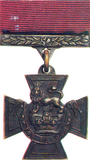
William Hackett
Sapper, 254th Tunneling Company. Corps of Royal Engineers
- Register No.
- 506 (Alf's numbering, from The Register of the Victoria Cross, 1997)
- Rank
- Sapper all Sappers →
- Unit
- 254th Tunneling Company. Corps of Royal Engineers all Corps of Royal Engineers VCs →
- Date of action
- 22–23 June 1916 on this day → all of 1916 →
- Conflict / campaign
- First World War
- London Gazette
- 5th August 1916 on this day → all of 1916 →
- Born
- 11th June 1873 at Nottingham
- Died
- 27th June 1916 at Givenchy, France
- Award
- Posthumous all posthumous VCs →
- Memorial / grave
- at: Ploegsteert Memorial, Belgium; The Market Hall, Mexborough, Yorkshire
Digest of citation
On the 22nd and 23rd of June 1916 at Shaftsbury Avenue Mine, near Gavenchy, France, Sapper Hackett was entombed with four others in a gallery, owing to the explosion of an enemy mine. After working for 24 hours a hole was made and the rescue party outside contacted. Sapper Hackett helped three of the men through the hole and could easily have followed but refused to leave the fourth man who had been seriously injured. The hole gradually got smaller, but he still refused to leave his injured comrade. Finally the gallery collapsed and although the rescue party worked desperately for four days, they were unable to reach the two men
From Alf Askin's research notes
Reproduced as Alf wrote it, c. 2000–2005. Spelling and abbreviations are his own.
HACKETT William (reg.No.506)
Sapper 254th Tunneling Company. Corps of Royal Engineers.
Gazetted on 5th August 1916.
Born on 11th June 1873 at Nottingham.
Died on 27th June 1916 at Givenchy, France.
Memorials are at: Ploegsteert Memorial, Belgium; The Market Hall, Mexborough, Yorkshire.
Digest of Citation reads: On the 22nd and 23rd of June 1916 at Shaftsbury Avenue Mine, near Gavenchy, France, Sapper Hackett was entombed with four others in a gallery, owing to the explosion of an enemy mine. After working for 24 hours a hole was made and the rescue party outside contacted. Sapper Hackett helped three of the men through the hole and could easily have followed but refused to leave the fourth man who had been seriously injured. The hole gradually got smaller, but he still refused to leave his injured comrade. Finally the gallery collapsed and although the rescue party worked desperately for four days, they were unable to reach the two men.
Additional information: Field-Marshall Sir Evelyn Wood VC wrote that this was ‘The most divine-like act of self sacrifice.' William Hackett was Born on to John and Harriet, on the 11th of June 1873, in Nottingham. Educated at the local school he left to go down the mines. He married Alice Tooby in 1900 and they had two chilren, a son and a daughter. After losing his job, he and Alice went to Mexborough to take a job, again in the mines. He was 41 years of age at the outbreak of the European War and he was eager to fight. He volunteered to join the local regiment, The York and Lancaster Regiment. He was turned down three times before being accepted in the Corps of Royal Engineers in the 254th Tunneling Company. This was a company used to dig tunnels under the enemy lines. It was sixteen days after his 43rd birthday that William Hackett gasve his life for a fellow tunneler. All is said, in his citation, of the unselfish and outstanding courage of William Hackett. He could have saved himself, returning perhaps to the bosom of his own family. This was one of the most outstanding acts of bravery that a man could perform. Perhaps THE bravest.
There is no greater sacrifice a man can make than to give his life for a comrade.
Additional information
Field-Marshall Sir Evelyn Wood VC wrote that this was ‘The most divine-like act of self sacrifice.' William Hackett was Born on to John and Harriet, on the 11th of June 1873, in Nottingham. Educated at the local school he left to go down the mines. He married Alice Tooby in 1900 and they had two chilren, a son and a daughter. After losing his job, he and Alice went to Mexborough to take a job, again in the mines. He was 41 years of age at the outbreak of the European War and he was eager to fight. He volunteered to join the local regiment, The York and Lancaster Regiment. He was turned down three times before being accepted in the Corps of Royal Engineers in the 254th Tunneling Company. This was a company used to dig tunnels under the enemy lines. It was sixteen days after his 43rd birthday that William Hackett gasve his life for a fellow tunneler. All is said, in his citation, of the unselfish and outstanding courage of William Hackett. He could have saved himself, returning perhaps to the bosom of his own family. This was one of the most outstanding acts of bravery that a man could perform. Perhaps THE bravest. There is no greater sacrifice a man can make than to give his life for a comrade.
Visit the grave or memorial
Alf recorded the memorial as: at: Ploegsteert Memorial, Belgium; The Market Hall, Mexborough, Yorkshire
Map links open a search for the place name Alf recorded; please check opening times and exact locations before travelling. Many VC graves have since been restored by the Victoria Cross Trust.
Research this recipient further
Would you like to honour William Hackett by sponsoring this page from £1 a month — in memory of someone, in your own name or for your company? Sponsor this page.