Frequently Asked Questions
About the Victoria Cross, and about this site.
Who was Alfred J. Askin?
Alf Askin (1929–2005) of Derby served in the RAF at St Athan and was a self-taught researcher who spent his retirement travelling to VC graves and memorials and reading some 250 books to compile this register. He answered hundreds of enquiries a month until his death on 29 July 2005. Read more.
Is this an official site?
No. It is a family memorial site based on Alf's personal research. Please verify facts against The London Gazette, the CWGC or the holding museum before relying on them.
Can I contact you or ask for research help?
We are sorry, but no. The site is maintained in Alf's memory and has no contact facility. The links page lists organisations that can help.
Can I sponsor a page or advertise?
Yes — sponsorship keeps the site online. See Support the Site.
How do I search for a recipient?
Use the search page to search by name, regiment, campaign, Gazette date, date of action or place, or browse the A–Z.
Can I use the information on this site?
You may quote Alf's entries for personal and educational research with a credit to 'Alfred J. Askin, victoriacross.co.uk'. Please do not copy the site wholesale.
How many Victoria Crosses have been awarded?
The standard figure is 1,358 awards to 1,355 recipients: three men (Martin-Leake, Chavasse and Upham) were awarded a Bar, and one Cross was given to the American Unknown Soldier in 1921. Counting the two retrospective VCs for Australia (Sheean 2020, Norden 2024) the total is 1,360 awards to 1,357 recipients. When Alf started this site in 2000 the register stood at 1,352 names.
Who was the first recipient?
The first act to be rewarded was that of Mate Charles Lucas, HMS Hecla, who threw a live shell overboard in the Baltic on 21 June 1854. The Cross was instituted by Royal Warrant on 29 January 1856 and the first 62 were presented by Queen Victoria in Hyde Park on 26 June 1857.
Who are the youngest and oldest recipients?
The youngest were Andrew Fitzgibbon (Hospital Apprentice, Taku Forts 1860) and Thomas Flynn (Drummer, Cawnpore 1857), both aged 15. The oldest was Lieutenant William Raynor, aged 61, at Delhi in 1857.
What is the Cross made of?
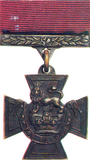
Tradition holds that the Crosses are cast from the bronze of guns captured at Sebastopol in the Crimea; the remaining block of metal is kept by the Royal Logistic Corps. Each Cross is made by Hancocks of London — see Alf's page on the reverse of the Cross.
How many are alive today?
7 living holders as of October 2026.
Where can I see Victoria Crosses?
The largest collection — Lord Ashcroft's, nearly 250 Crosses — is moving to the National Army Museum in Chelsea after the IWM gallery closed in 2025. Many regimental museums hold their own. See Places to Visit.
Which action produced the most VCs?
Rorke's Drift, 22–23 January 1879: eleven Crosses. The 'six VCs before breakfast' at W Beach, Gallipoli, 25 April 1915, is the most for a single battalion in a morning. See Rorke's Drift.