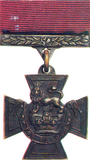
Reginald Frederick Johnson Hayward
Captain, 1st Battalion, Wiltshire Regiment
- Register No.
- 550 (Alf's numbering, from The Register of the Victoria Cross, 1997)
- Rank
- Captain (register: Acting Captain) all Captains →
- Unit
- 1st Battalion, Wiltshire Regiment (register: Duke of Edinburgh's (Wiltshire Regiment)) all Duke of Edinburgh's (Wiltshire Regiment) VCs →
- Date of action
- 21–22 March 1918 on this day → all of 1918 →
- Conflict / campaign
- First World War
- London Gazette
- 24th April, 1918 on this day → all of 1918 →
- Born
- 17th June, 1891 at Beersheba, East Griqualand, South Africa
- Died
- 17th January 1978 in London
- Memorial / grave
- not known
Digest of citation
On 21st/22nd March, 1918 near Fremicourt, France, while commanding a company, Captain Hayward displayed almost superhuman powers of endurance. In spite of the fact that he was buried, wounded in the head and rendered deaf on the first day of operations and had his arm shattered two days later, he refused to leave his men, even though he received a third serious injury to his head, until he collapsed from sheer exhaustion. Throughout this period the enemy were attacking the company's front without cessation, but Captain Hayward continued to move across the open from one trench to another with absolute disregard for his own safety
From Alf Askin's research notes
Reproduced as Alf wrote it, c. 2000–2005. Spelling and abbreviations are his own.
HAYWARD, Reginald Frederick Johnson. (reg No. 550).
Captain. 1st Battalion, Wiltshire Regiment.
London Gazetted on 24th April, 1918.
Born on 17th June, 1891 at Beersheba, East Griqualand, South Africa.
Died on 17th January 1978 in London.
Memorial not known.
Digest of Citation reads: On 21st/22nd March, 1918 near Fremicourt, France, while commanding a company, Captain Hayward displayed almost superhuman powers of endurance. In spite of the fact that he was buried, wounded in the head and rendered deaf on the first day of operations and had his arm shattered two days later, he refused to leave his men, even though he received a third serious injury to his head, until he collapsed from sheer exhaustion. Throughout this period the enemy were attacking the company's front without cessation, but Captain Hayward continued to move across the open from one trench to another with absolute disregard for his own safety.
Additional information:. Lieutenant Colonel Hayward also held the Military Cross (MC) and Bar and the ED (not yet identified this Medal). He served in World War Two as CRASC (Anti-Aircraft Command) and then as Commandant of Prisoner of War Camps from 1945-47.
Additional information
Lieutenant Colonel Hayward also held the Military Cross (MC) and Bar and the ED (not yet identified this Medal). He served in World War Two as CRASC (Anti-Aircraft Command) and then as Commandant of Prisoner of War Camps from 1945-47.
Visit the grave or memorial
Alf recorded the memorial as: not known
Map links open a search for the place name Alf recorded; please check opening times and exact locations before travelling. Many VC graves have since been restored by the Victoria Cross Trust.
Research this recipient further
Would you like to honour Reginald Frederick Johnson Hayward by sponsoring this page from £1 a month — in memory of someone, in your own name or for your company? Sponsor this page.