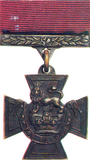
Nigel Gray Leakey
Sergeant, 1st/6th Battalion. King's African Rifles
- Register No.
- 728 (Alf's numbering, from The Register of the Victoria Cross, 1997)
- Rank
- Sergeant all Sergeants →
- Unit
- 1st/6th Battalion. King's African Rifles all King's African Rifles VCs →
- Date of action
- 19 May 1941 on this day → all of 1941 →
- Conflict / campaign
- Second World War
- London Gazette
- 15th November 1945 on this day → all of 1945 →
- Born
- 1st January 1913 in Kenya
- Died
- in action on 19th May, 1941 near Colito, Abyssinia
- Award
- Posthumous all posthumous VCs →
Digest of citation
Near Colito in Abyssinia, 19th May, 1941, two Allied companies had established a precarious bridgehead against strong opposition. A sudden counter-attack, by the Italians, was made with light and medium tanks, threatening to overrun the two companies of the King's African Rifles. One of the tanks advanced. from the rear, on troops who had no anti-tank weapons. In the face of withering fire from enemy machine guns, Sergeant Leakey leapt on top of the tank, wrenched open the turret and shot all the crew with the exception of the driver, whom he forced to drive into cover. Failing to get the tank's gun to fire, he charged across ground that was being raked by machine gun and shell fire from the other Italian tanks. Along with two other Askari and an African CSM he stalked the other tanks. Two tanks passed, and Sergeant Leakey clambered onto the third opened the turret and shot one of the crew, before being shot off the turret by the machine gun of a following tank. Throughout the action he displayed Valour of the highest order and his action broke up the Italian tank attack
From Alf Askin's research notes
Reproduced as Alf wrote it, c. 2000–2005. Spelling and abbreviations are his own.
LEAKEY, Nigel Gray. (reg No. 728).
Sergeant. 1st/6th Battalion. King's African Rifles.
London Gazetted on 15th November 1945.
Born on 1st January 1913 in Kenya.
Killed in action on 19th May, 1941 near Colito, Abyssinia. Remembered on East Africa Memorial, Nairobi, Kenya.
Digest of Citation reads: Near Colito in Abyssinia, 19th May, 1941, two Allied companies had established a precarious bridgehead against strong opposition. A sudden counter-attack, by the Italians, was made with light and medium tanks, threatening to overrun the two companies of the King's African Rifles. One of the tanks advanced. from the rear, on troops who had no anti-tank weapons. In the face of withering fire from enemy machine guns, Sergeant Leakey leapt on top of the tank, wrenched open the turret and shot all the crew with the exception of the driver, whom he forced to drive into cover. Failing to get the tank's gun to fire, he charged across ground that was being raked by machine gun and shell fire from the other Italian tanks. Along with two other Askari and an African CSM he stalked the other tanks. Two tanks passed, and Sergeant Leakey clambered onto the third opened the turret and shot one of the crew, before being shot off the turret by the machine gun of a following tank. Throughout the action he displayed Valour of the highest order and his action broke up the Italian tank attack..
Additional information:. Sergeant Leakey was recommended for the Victoria Cross by men of the King's African Rifles, whose only language was Swahili and they signed the recommendation with their thumbprints. After translation to CIGC and others they approved it. Lieutenant General Floyer-Acland, Military Secretary, didn't. Although he thought Sergeant Leakey displayed great gallantry, he regarded the action as one of being on the "spur-of-the-moment." He thought it lacked sustained courage and endurance. In other words the action had been too brief and the recommendations were ignored.. When the recommendation was resubmitted in 1945, and further evidence of his exploits were supplied,. they then knew that his courage, in fact, had been sustained. John Laffin, in his book, "British VCs of World War Two, a Study in Heroism,". says that Floyer-Acland had been regarded as a bottleneck by his colleagues and when he was no longer Military Secretary, King George VI readily approve the Award .
Additional information
Sergeant Leakey was recommended for the Victoria Cross by men of the King's African Rifles, whose only language was Swahili and they signed the recommendation with their thumbprints. After translation to CIGC and others they approved it. Lieutenant General Floyer-Acland, Military Secretary, didn't. Although he thought Sergeant Leakey displayed great gallantry, he regarded the action as one of being on the "spur-of-the-moment." He thought it lacked sustained courage and endurance. In other words the action had been too brief and the recommendations were ignored.. When the recommendation was resubmitted in 1945, and further evidence of his exploits were supplied,. they then knew that his courage, in fact, had been sustained. John Laffin, in his book, "British VCs of World War Two, a Study in Heroism,". says that Floyer-Acland had been regarded as a bottleneck by his colleagues and when he was no longer Military Secretary, King George VI readily approve the Award .
Remembered on East Africa Memorial, Nairobi, Kenya.
Places connected with Leakey
Research this recipient further
Would you like to honour Nigel Gray Leakey by sponsoring this page from £1 a month — in memory of someone, in your own name or for your company? Sponsor this page.