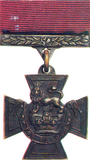
Mark Walker
Lieutenant, 30th Regiment
- Register No.
- 1260 (Alf's numbering, from The Register of the Victoria Cross, 1997)
- Rank
- Lieutenant all Lieutenants →
- Unit
- 30th Regiment (register: 30th Regiment of Foot) all 30th Regiment of Foot VCs →
- Date of action
- 5 November 1854 on this day → all of 1854 →
- Conflict / campaign
- Crimean War
- London Gazette
- 2nd June 1858 on this day → all of 1858 →
- Born
- 24th November 1827 at Gore Port, Finca, County Westmeath,
- Died
- 18th July 1902 at Arlington, Devon
- Memorial / grave
- at Cheriton Road Cemetery, Folkestone, Kent, also in Canterbury Cathedral
- Medal held by
- the National Army Museum, London
Digest of citation
On 5th November 1854, Lieutenant Walker distinguished himself before his regiment, by jumping over a wall at Inkerman, Crimea, to face the oncoming two battalions of Russian infantry. His purpose was to encourage his comrades by setting an example and then advance against a far superior force. He succeeded in, not only getting support from his men, but also in driving back the two battalions
From Alf Askin's research notes
Reproduced as Alf wrote it, c. 2000–2005. Spelling and abbreviations are his own.
WALKER, Mark. (reg No. 1260).
Lieutenant. 30th Regiment. * London Gazetted on 2nd June 1858.
VC Medal's Custodian is the National Army Museum, London.
Born on 24th November 1827 at Gore Port, Finca, County Westmeath, Ireland.
Died on 18th July 1902 at Arlington, Devon.
Memorial on grave at Cheriton Road Cemetery, Folkestone, Kent, also in Canterbury Cathedral.
Digest of Citation reads: On 5th November 1854, Lieutenant Walker distinguished himself before his regiment, by jumping over a wall at Inkerman, Crimea, to face the oncoming two battalions of Russian infantry. His purpose was to encourage his comrades by setting an example and then advance against a far superior force. He succeeded in, not only getting support from his men, but also in driving back the two battalions .
* East Lancashire Regiment.
Additional information:. General Sir Mark Walker, also held the Knight Commander of the Order of the Bath (KCB). It was reported that as the Russians grew nearer, the position grew desperate. Lieutenant Walker realised that his men might become nervous, so seizing the psychological moment, he jumped over the wall, calling for his troops to follow, with bayonets fixed. The Russians became panic-stricken at their sudden appearance before them. Despite the threats and cajoling of their superior officers they retreated swiftly in disorder. They were pursued for some distance by Lieutenant Walker and his men. He later led an attack on a Russian rifle pit, and destroyed it. After this he went to the Buffs where he was severely wounded in action, resulting in the loss of his right arm. He had a distinguished career in the army, serving in the China war, which included the capture of the Taku Forts. He was mentioned in despatches, receiving the medal with two clasps. In 1861 he was promoted Brevet Lieutenant Colonel. In 1881 he married Catherine Chichester, after which he lived at 10, Castle Avenue, Folkestone. He died at Arlington, Devon. His medals were presented to the first Battalion (miniatures) along with his grey overcoat and watch. In his memory, a bed was endowed at the Union Jack Club.
Additional information
General Sir Mark Walker, also held the Knight Commander of the Order of the Bath (KCB). It was reported that as the Russians grew nearer, the position grew desperate. Lieutenant Walker realised that his men might become nervous, so seizing the psychological moment, he jumped over the wall, calling for his troops to follow, with bayonets fixed. The Russians became panic-stricken at their sudden appearance before them. Despite the threats and cajoling of their superior officers they retreated swiftly in disorder. They were pursued for some distance by Lieutenant Walker and his men. He later led an attack on a Russian rifle pit, and destroyed it. After this he went to the Buffs where he was severely wounded in action, resulting in the loss of his right arm. He had a distinguished career in the army, serving in the China war, which included the capture of the Taku Forts. He was mentioned in despatches, receiving the medal with two clasps. In 1861 he was promoted Brevet Lieutenant Colonel. In 1881 he married Catherine Chichester, after which he lived at 10, Castle Avenue, Folkestone. He died at Arlington, Devon. His medals were presented to the first Battalion (miniatures) along with his grey overcoat and watch. In his memory, a bed was endowed at the Union Jack Club.
* East Lancashire Regiment.
Ireland.
Visit the grave or memorial
Alf recorded the memorial as: at Cheriton Road Cemetery, Folkestone, Kent, also in Canterbury Cathedral
Map links open a search for the place name Alf recorded; please check opening times and exact locations before travelling. Many VC graves have since been restored by the Victoria Cross Trust.
Research this recipient further
Would you like to honour Mark Walker by sponsoring this page from £1 a month — in memory of someone, in your own name or for your company? Sponsor this page.