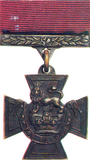
Henry Peel Ritchie
Commander, Royal Navy
- Register No.
- 1055 (Alf's numbering, from The Register of the Victoria Cross, 1997)
- Rank
- Commander all Commanders →
- Unit
- Royal Navy (register: HMS Goliath) all HMS Goliath VCs →
- Date of action
- 28 November 1914 on this day → all of 1914 →
- Conflict / campaign
- First World War
- London Gazette
- 10th April 1915 on this day → all of 1915 →
- Born
- 29th January 1876 at Melville Gardens, Edinburgh, Scotland
- Died
- 9th December 1958, aged 83, at Craig Royston House, Edinburgh,
- Memorial / grave
- Cremated at Warriston Crematorium, Edinburgh, Scotland
Digest of citation
At Dar-ess-Salaam, in East Africa, on 29th November 1914, Commander Richie of HMS Goliath, whilst in command of searching and demolition operations aboard a small steam vessel fitted with a Maxim gun , showed most conspicuous bravery. Although wounded several times, Commander Richie fortitude and resolution enabled him to do his duty, inspiring all around him by his example, until his final wound, the eighth, caused him to become unconscious from loss of blood
From Alf Askin's research notes
Reproduced as Alf wrote it, c. 2000–2005. Spelling and abbreviations are his own.
RITCHIE, Henry Peel. (reg No. 1055).
Commander. Royal Navy.
London Gazetted on 10th April 1915.
Born on 29th January 1876 at Melville Gardens, Edinburgh, Scotland.
Died on 9th December 1958, aged 83, at Craig Royston House, Edinburgh, Scotland. Cremated at Warriston Crematorium, Edinburgh, Scotland.
Digest of Citation reads: At Dar-ess-Salaam, in East Africa, on 29th November 1914, Commander Richie of HMS Goliath, whilst in command of searching and demolition operations aboard a small steam vessel fitted with a Maxim gun , showed most conspicuous bravery. Although wounded several times, Commander Richie fortitude and resolution enabled him to do his duty, inspiring all around him by his example, until his final wound, the eighth, caused him to become unconscious from loss of blood.
Additional information:. Commander Richie was the first naval officer in World War One (WW I) to win the Victoria Cross. (The Deed, not the Gazetted date.) The harbour was peaceful, white flags were flying from the harbour flagstaffs. Accompanied by two small craft they entered the harbour unchallenged. They sailed around the harbour sinking, or seriously damaging, virtually anything that floated. Still not a shot had been fired. The Konigsberg was disabled, Ritchie himself having gone on board. Whilst on board the second ship, Kaiser Wilhelm II, Commander Richie's suspicions were aroused when, although the ship was almost deserted, he saw a clip of Mauser bullets. He lashed two steel lighters to his small vessel, one each side. They would serve, if they got into shallow water, as a warning when they struck the bottom first. This would make it possible for the steamboat to be released and make their getaway. Firing started, even though white flags were flying. When they headed the strange craft out of the harbour, they were met by a hail of shells and bullets coming from every direction. Commander Richie was wounded, then Petty Officer Clark and Able Seaman Upton were severely injured and unable to carry out their duties. Commander Richie took charge of the ships wheel. His eighth and final wound took him out of action altogether. Sub Lieutenant Loyd had been severely wounded also, so Petty Officer Clarke took over once more, directing the ship to the safety of the open sea. Petty Officer Thomas Clark received Conspicuous Gallantry Medal (CGM), and Able Seaman George Upton was awarded the Distinguished Service Medal (DSM). Able Seaman Upton lost his life when HMS Goliath was sunk.
Additional information
Commander Richie was the first naval officer in World War One (WW I) to win the Victoria Cross. (The Deed, not the Gazetted date.) The harbour was peaceful, white flags were flying from the harbour flagstaffs. Accompanied by two small craft they entered the harbour unchallenged. They sailed around the harbour sinking, or seriously damaging, virtually anything that floated. Still not a shot had been fired. The Konigsberg was disabled, Ritchie himself having gone on board. Whilst on board the second ship, Kaiser Wilhelm II, Commander Richie's suspicions were aroused when, although the ship was almost deserted, he saw a clip of Mauser bullets. He lashed two steel lighters to his small vessel, one each side. They would serve, if they got into shallow water, as a warning when they struck the bottom first. This would make it possible for the steamboat to be released and make their getaway. Firing started, even though white flags were flying. When they headed the strange craft out of the harbour, they were met by a hail of shells and bullets coming from every direction. Commander Richie was wounded, then Petty Officer Clark and Able Seaman Upton were severely injured and unable to carry out their duties. Commander Richie took charge of the ships wheel. His eighth and final wound took him out of action altogether. Sub Lieutenant Loyd had been severely wounded also, so Petty Officer Clarke took over once more, directing the ship to the safety of the open sea. Petty Officer Thomas Clark received Conspicuous Gallantry Medal (CGM), and Able Seaman George Upton was awarded the Distinguished Service Medal (DSM). Able Seaman Upton lost his life when HMS Goliath was sunk.
Scotland.
Visit the grave or memorial
Alf recorded the memorial as: Cremated at Warriston Crematorium, Edinburgh, Scotland
Map links open a search for the place name Alf recorded; please check opening times and exact locations before travelling. Many VC graves have since been restored by the Victoria Cross Trust.
Research this recipient further
Would you like to honour Henry Peel Ritchie by sponsoring this page from £1 a month — in memory of someone, in your own name or for your company? Sponsor this page.