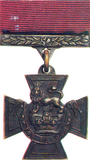
George Evans
Company Sergeant-Major, 18th Battalion, Manchester Regiment
- Register No.
- 389 (Alf's numbering, from The Register of the Victoria Cross, 1997)
- Rank
- Company Sergeant-Major (register: Company Sergeant Major) all Company Sergeant-Majors →
- Unit
- 18th Battalion, Manchester Regiment all Manchester Regiment VCs →
- Date of action
- 30 July 1916 on this day → all of 1916 →
- Conflict / campaign
- First World War
- London Gazette
- 30th January 1920 on this day → all of 1920 →
- Born
- 16th February 1876 at Kensington, London
- Died
- 28th September 1937 at Sydenham, Kent
- Memorial / grave
- at Elmers End Cemetery, Beckenham, Kent
Digest of citation
On 30th July 1916 at Guillemont, France, Company Sergeant-Major Evans volunteered to take back an important message after five runners had been killed in attempting to do so. He had to cover about 700 yards, the whole of which was under observation from the enemy. He succeeded in delivering the message in spite of being wounded and rejoined his company although advised to go to the dressing station. The return journey had again meant facing 700 yards of severe rifle and machine-gun fire, but by dodging from shell-hole to shell-hole he managed it
From Alf Askin's research notes
Reproduced as Alf wrote it, c. 2000–2005. Spelling and abbreviations are his own.
EVANS, George. (reg No. 389).
Company Sergeant-Major 18th Battalion, Manchester Regiment.
London Gazetted on 30th January 1920.
Born on 16th February 1876 at Kensington, London.
Died on 28th September 1937 at Sydenham, Kent.
Memorial on grave at Elmers End Cemetery, Beckenham, Kent.
Digest of Citation reads: On 30th July 1916 at Guillemont, France, Company Sergeant-Major Evans volunteered to take back an important message after five runners had been killed in attempting to do so. He had to cover about 700 yards, the whole of which was under observation from the enemy. He succeeded in delivering the message in spite of being wounded and rejoined his company although advised to go to the dressing station. The return journey had again meant facing 700 yards of severe rifle and machine-gun fire, but by dodging from shell-hole to shell-hole he managed it.
Additional information:. C S M Evans was the last person to be Gazetted for the Victoria Cross in the First World War. His mother Died on when he was six weeks old and his father Died on when he was 13. He looked after himself from that time on. He was educated at various schools in the London area. He joined the army on 5th March 1894 in the Scots Guards. He served the South Africa War from 1899-1902 with the first Battalion. He saw service, for six months, in the Orange Free State, seeing action at Belmont and Modder River. During this war he went on the strength of the Imperial Representative Corps, accompanying the Duke and Duchess of Cornwall and York (later King George V, and Queen Mary) on their tour of Australia during the Commonwealth Celebrations. After the tour he returned to South Africa serving in the later part of the Boer War. He left the Scots Guards in August 1902 after serving as an instructor. He joined the NSPCC and became an inspector. He enlisted in the Manchester Regiment on 4th January 1915. From 30th July 1916 he was a prisoner of war. In the European War, apart from the occasion of his winning the Victoria Cross, he had displayed great bravery at Montauban and Trónes Wood and was always a splendid example to his men. He was married , his wife's name was Clara (née Bates) and they had four children whose names were, Daniel Jones, Constance, Viola May and George.
Additional information
C S M Evans was the last person to be Gazetted for the Victoria Cross in the First World War. His mother Died on when he was six weeks old and his father Died on when he was 13. He looked after himself from that time on. He was educated at various schools in the London area. He joined the army on 5th March 1894 in the Scots Guards. He served the South Africa War from 1899-1902 with the first Battalion. He saw service, for six months, in the Orange Free State, seeing action at Belmont and Modder River. During this war he went on the strength of the Imperial Representative Corps, accompanying the Duke and Duchess of Cornwall and York (later King George V, and Queen Mary) on their tour of Australia during the Commonwealth Celebrations. After the tour he returned to South Africa serving in the later part of the Boer War. He left the Scots Guards in August 1902 after serving as an instructor. He joined the NSPCC and became an inspector. He enlisted in the Manchester Regiment on 4th January 1915. From 30th July 1916 he was a prisoner of war. In the European War, apart from the occasion of his winning the Victoria Cross, he had displayed great bravery at Montauban and Trónes Wood and was always a splendid example to his men. He was married , his wife's name was Clara (née Bates) and they had four children whose names were, Daniel Jones, Constance, Viola May and George.
Visit the grave or memorial
Alf recorded the memorial as: at Elmers End Cemetery, Beckenham, Kent
Map links open a search for the place name Alf recorded; please check opening times and exact locations before travelling. Many VC graves have since been restored by the Victoria Cross Trust.
Research this recipient further
Would you like to honour George Evans by sponsoring this page from £1 a month — in memory of someone, in your own name or for your company? Sponsor this page.