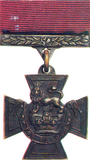
Ernest Herbert Pitcher
Petty Officer, Royal Navy
- Register No.
- 988 (Alf's numbering, from The Register of the Victoria Cross, 1997)
- Rank
- Petty Officer all Petty Officers →
- Unit
- Royal Navy (register: HMS Dunraven) all HMS Dunraven VCs →
- Date of action
- 8 August 1917 on this day → all of 1917 →
- Conflict / campaign
- First World War
- London Gazette
- the 2nd November 1917 on this day → all of 1917 →
- Born
- 31st December 1888 at Mullion, Cornwall
- Died
- 10th February 1946 at Sherborne, Dorset
- Memorial / grave
- at Swanage Cemetery, Dorset and in Swanage Parish Church
Digest of citation
Petty Officer Pitcher was the gunlayer of the four-inch gun aboard HMS Dunraven, a 'Q' ship * when she was shelled by a German submarine on 8th August 1917, in the Bay of Biscay. Petty Officer Pitcher, along with the rest of the crew waited in hiding. A shell, the first of three, caused the debt charge to detonate, and the second and third shells starting a fire. They rescued some of the ammunition and kept the boxes on their knees to prevent them getting overheated and exploding. When an explosion blew up the four inch gun, the crew was blown into the air. Luckily they landed on mock railway trucks, disguised as cargo, made of canvas and wood, although one of them fell into the sea. a simple merchant ship. Information regarding the event : On 8th August 1917, HMS Dunraven, a 'Q'ship, sighted a U-boat , UC71, and because she was disguised as an unobservant merchantman the submarine did not dive for some time . The submarine eventually dived but surfaced, shortly after, dead astern of the Dunraven. The U-boat opened fire at 5000 yards. Commander Gordon Campbell sent frantic signals and made smoke. On the poop deck the two-and-half pound gun gave a fine example of poor shooting . The shelling continued for half-an-hour but failed to hit. The U-boat slowly closed the distance. Campbell took advantage of a near miss, to stop the ship. From a donkey boiler he created clouds of steam amidships and sending away the Panic party*. Then turning hard to port to bring the guns to bear. Unfortunately the U-boat, now only 1000 yards away, made three hits on the Dunraven. The first hit exploded a depth charge, blowing Lieutenant Bonner from his hiding place. A fire was started on the deck. The remainder of the crew remained in hiding as a fire raged below, in the ammunition store. Billowing smoke hid the UC71 as she crossed the stern. Realising that the after guns and their crews could be blown up at any time, Campbell waited for the submarine to come out of the smoke. As she came into view an explosion caused the four-inch gun and his crew to be blown into the air. Luckily their falls were broken by 'mock railway trucks', simulating cargo, made of wood and canvas. One man fell into the sea. Realisation that this was a 'Q' ship caused the UC 71 to crash dive but not before the Dunraven managed to fire two shots. Campbell sent away another Panic party in the hope that the U-boat would think that they were sinking. However the UC71 returned hitting her near the stern with a torpedo. The original Panic party returned and a third Panic party left on a raft. After Campbell had fired torpedoes at the U-boat and missed, the UC 71, having no torpedoes left, disappeared and was never seen again
From Alf Askin's research notes
Reproduced as Alf wrote it, c. 2000–2005. Spelling and abbreviations are his own.
PITCHER, Ernest Herbert. (reg No. 988).
Petty Officer. Royal Navy.
London Gazetted on the 2nd November 1917.
Born on 31st December 1888 at Mullion, Cornwall.
Died on 10th February 1946 at Sherborne, Dorset.
Memorial on grave at Swanage Cemetery, Dorset and in Swanage Parish Church Digest of Citation reads: Petty Officer Pitcher was the gunlayer of the four-inch gun aboard HMS Dunraven, a 'Q' ship * when she was shelled by a German submarine on 8th August 1917, in the Bay of Biscay. Petty Officer Pitcher, along with the rest of the crew waited in hiding. A shell, the first of three, caused the debt charge to detonate, and the second and third shells starting a fire. They rescued some of the ammunition and kept the boxes on their knees to prevent them getting overheated and exploding. When an explosion blew up the four inch gun, the crew was blown into the air. Luckily they landed on mock railway trucks, disguised as cargo, made of canvas and wood, although one of them fell into the sea.
* A 'Q' ship was a ship, manned by the Royal Navy, disguised as a simple merchant ship. Information regarding the event : On 8th August 1917, HMS Dunraven, a 'Q'ship, sighted a U-boat , UC71, and because she was disguised as an unobservant merchantman the submarine did not dive for some time . The submarine eventually dived but surfaced, shortly after, dead astern of the Dunraven. The U-boat opened fire at 5000 yards. Commander Gordon Campbell sent frantic signals and made smoke. On the poop deck the two-and-half pound gun gave a fine example of poor shooting . The shelling continued for half-an-hour but failed to hit. The U-boat slowly closed the distance. Campbell took advantage of a near miss, to stop the ship. From a donkey boiler he created clouds of steam amidships and sending away the Panic party*. Then turning hard to port to bring the guns to bear. Unfortunately the U-boat, now only 1000 yards away, made three hits on the Dunraven. The first hit exploded a depth charge, blowing Lieutenant Bonner from his hiding place. A fire was started on the deck. The remainder of the crew remained in hiding as a fire raged below, in the ammunition store. Billowing smoke hid the UC71 as she crossed the stern. Realising that the after guns and their crews could be blown up at any time, Campbell waited for the submarine to come out of the smoke. As she came into view an explosion caused the four-inch gun and his crew to be blown into the air. Luckily their falls were broken by 'mock railway trucks', simulating cargo, made of wood and canvas. One man fell into the sea. Realisation that this was a 'Q' ship caused the UC 71 to crash dive but not before the Dunraven managed to fire two shots. Campbell sent away another Panic party in the hope that the U-boat would think that they were sinking. However the UC71 returned hitting her near the stern with a torpedo. The original Panic party returned and a third Panic party left on a raft. After Campbell had fired torpedoes at the U-boat and missed, the UC 71, having no torpedoes left, disappeared and was never seen again.
Additional information: Petty Officer Pitcher was elected by ballot, for the Victoria Cross, under Rule 13 of the Royal Warrant of 29th January 1856. Lieutenant Bonner was also awarded the Victoria Cross.
Additional information
Petty Officer Pitcher was elected by ballot, for the Victoria Cross, under Rule 13 of the Royal Warrant of 29th January 1856. Lieutenant Bonner was also awarded the Victoria Cross.
* A 'Q' ship was a ship, manned by the Royal Navy, disguised as
Visit the grave or memorial
Alf recorded the memorial as: at Swanage Cemetery, Dorset and in Swanage Parish Church
Map links open a search for the place name Alf recorded; please check opening times and exact locations before travelling. Many VC graves have since been restored by the Victoria Cross Trust.
Research this recipient further
Would you like to honour Ernest Herbert Pitcher by sponsoring this page from £1 a month — in memory of someone, in your own name or for your company? Sponsor this page.