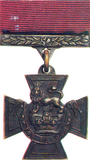
Charles George Baker
Lieutenant, Bengal Police Battalion
- Register No.
- 46 (Alf's numbering, from The Register of the Victoria Cross, 1997)
- Rank
- Lieutenant all Lieutenants →
- Unit
- Bengal Police Battalion all Bengal Police Battalion VCs →
- Date of action
- 27 September 1858 on this day → all of 1858 →
- Conflict / campaign
- Indian Mutiny
- London Gazette
- 8th June 1917 on this day → all of 1917 →
- Born
- 8th December 1830 at Neocolly, Bengal
- Died
- 19th February 1906 at Southbourne-on-Sea, Hampshire
- Memorial / grave
- Not Known. Memorials at The German extension of Annoellin Communal Cemetery, Nottingham Castle in the Walled Garden and at the site of his crash at the East side of the Cemetery
- Medal held by
- the Sherwood Forester's Museum, Nottingham
Digest of citation
On 27 September 1858 at Suhejnee, near Peroo, Bengal, Lieutenant Baker was in command of a mixed party of cavalry and mounted police( about 120 strong) which attacked and put to flight a force of about 700 rebels. The whole operation brilliantly conceived and most gallantly carried out, resulted in the utter defeat of the enemy.(See also G.B.Chicken Reg. No.211) From the 26th of April to the 6th May 1917, over France, Captain Ball took Pat in 26 Combats in the course of which he destroyed 11 hostile aircraft, brought down two out of control and forced several others to land. Flying alone, on one occasion he fought six hostile machines, twice he fought five and once four. When leading two other British planes he attacked an enemy formation of eight - on each of these occasions he brought down at least one enemy plane, and several times he returned his plane was badly damaged. On returning with a damaged plane he had always to be restrained from immediately going out in another
From Alf Askin's research notes
Reproduced as Alf wrote it, c. 2000–2005. Spelling and abbreviations are his own.
BAKER, Charles George. (Reg No. 46)
Lieutenant Bengal Police Battalion London Gazetted on 25th February 1862.
Born on 8th December 1830 at Neocolly, Bengal.
Died on 19th February 1906 at Southbourne-on-Sea, Hampshire.
Memorial Not Known.
Digest of Citation reads: On 27 September 1858 at Suhejnee, near Peroo, Bengal, Lieutenant Baker was in command of a mixed party of cavalry and mounted police( about 120 strong) which attacked and put to flight a force of about 700 rebels. The whole operation brilliantly conceived and most gallantly carried out, resulted in the utter defeat of the enemy.(See also G.B.Chicken Reg. No.211)
Additional information: Lieutenant Baker started his career with the P&O Company . Whilst serving on the SS Duro she was wrecked, in 1854, on the Paracel Shoal. Along with six others, he volunteered to go in an open boat for 500 miles, with little food and water, in seas infested with Chinese pirates in order to get help. They succeeded. He served with great distinction, during the Indian Mutiny, in The Bengal Police. His Victoria Cross was awarded for the attack with a combined force of 123 men, consisting of the Irregular cavalry and 3rd Sikhs. When his health failed him he took service with the Sultan of Turkey He was taken prisoner by the Russians whilst serving under Valentine Baker Pasha in the Campaign in the Balkans. He went with Valentine Baker to Egypt serving under him and eventually succeeding him as Commander of the Egyptian Police. He was made Major-General (lena Pasha), Head of the Public Security Department of the Egyptian Ministry of the Interior. He retired in 1885 to live in Southbourne-on-Sea, in Hampshire, where he Died on, eleven years later, at the age of 76.
BALL, Albert (Reg. No.47.) Temp.Captain 7th Battalion Sherwood Foresters (Notts & Derby) and Royal Flying Corps.
London Gazetted on 8th June 1917 VC Medal's Custodian is the Sherwood Forester's Museum, Nottingham Castle, Nottingham.
Born on 14th August 1896 at Lenton, Nottingham.
Died on 7th May 1917 at Annoellin, France.
Memorials at The German extension of Annoellin Communal Cemetery, Nottingham Castle in the Walled Garden and at the site of his crash at the East side of the Cemetery.
.Digest of Citation reads: From the 26th of April to the 6th May 1917, over France, Captain Ball took Pat in 26 Combats in the course of which he destroyed 11 hostile aircraft, brought down two out of control and forced several others to land. Flying alone, on one occasion he fought six hostile machines, twice he fought five and once four. When leading two other British planes he attacked an enemy formation of eight - on each of these occasions he brought down at least one enemy plane, and several times he returned his plane was badly damaged. On returning with a damaged plane he had always to be restrained from immediately going out in another.
Additional information: He already held the Distinguished Service Order and 2 Bars as well as the MilitaryCross. Also the Legion D'Honneur of France and the Russian Order of St. George 4th Class There is a book about his life and career, Captain Ball VC by Walter A. Briscoe and H. Russell Stannard.. Albert BALL was Born on the 14th August 1896 the son of Alderman and Mrs Albert Ball. His father was an estate agent as well as being a local politician, a JP and Mayor. He was educated at Grantham Grammar School followed by Nottingham High School finally attending Trent College.His father had interests in engineering firms and young Albert took an interest in anything mechanical or electrical. At the age of seventeen he bought an interest in a Nottingham engineering firm. He was one of the first to volunteer at the outbreak of the European War (WW 1), joining the Nottingham 2/7th Battalion of the Sherwood Foresters (The Robin Hood Territorial Battalion). He was in Kitchener.s first 100,000. On the 28th October 1914 he became a Second Lieutenant, promoted to Lieutenant on the 10th August 1916 before becoming a Captain and Flight Commander a month later on the 13th September 1916. It was whilst he was serving with the Sherwood Foresters that he rose in the morning and traveled from Luton to Hendon, a return journey of 60 miles, in order to take flying lessons. He would do his days work with his regiment, then return to Hendon in the evening for more lessons. He attended church whenever possible, never wavering in his belief in God "No vice had ever made his vision blurred or his hand shake, and he practised and worked, using to the uttermost the gifts of God which he had not marred by evil thinking or living." His enthusiasm, for flying, was such that he spent most of his time on the ground maintaining his aircraft and its weapons. In spite of his bravery he was always a boy at heart as letters home showed. He was very fond of adjectives like ripping. An excerpt from a letter to his sister said, "I was so pleased to get your ripping cake, but I have nearly finished it. I love to take a huge piece with me when I fly." another said, "I then took a dive to the ground and landed ripping." He also kept himself very fit Whilst on leave and pressed for stories of his combats he told of the skill of an enemy pilot. The Hun, as he tended to call them, was as evasive as he himself was. Attacking from above, below and from the sides, each taking the evasive required it was not too long before they were both out of ammunition. They flew side by side waving at each other and both couldn't help but laugh at the situation. They waved goodbye and flew home. On August the 30th, 1916 he wrote to his sister that he had been asked for a list of his actions. The list stated that he had been involved in 84 Combats; 11 machines and 1 balloon brought down and seen to crash; 5 machines brought down but not seen to crash; 12 machines forced down and damaged. After being told by his Major that he had more Huns to his credit than any other English or French pilots, his simple statement said, ‘So its not so bad. I have done my best.'
Additional information
Lieutenant Baker started his career with the P&O Company . Whilst serving on the SS Duro she was wrecked, in 1854, on the Paracel Shoal. Along with six others, he volunteered to go in an open boat for 500 miles, with little food and water, in seas infested with Chinese pirates in order to get help. They succeeded. He served with great distinction, during the Indian Mutiny, in The Bengal Police. His Victoria Cross was awarded for the attack with a combined force of 123 men, consisting of the Irregular cavalry and 3rd Sikhs. When his health failed him he took service with the Sultan of Turkey He was taken prisoner by the Russians whilst serving under Valentine Baker Pasha in the Campaign in the Balkans. He went with Valentine Baker to Egypt serving under him and eventually succeeding him as Commander of the Egyptian Police. He was made Major-General (lena Pasha), Head of the Public Security Department of the Egyptian Ministry of the Interior. He retired in 1885 to live in Southbourne-on-Sea, in Hampshire, where he Died on, eleven years later, at the age of 76. BALL, Albert (Reg. No.47.) Temp.Captain 7th Battalion Sherwood Foresters (Notts & Derby) and Royal Flying Corps. He already held the Distinguished Service Order and 2 Bars as well as the MilitaryCross. Also the Legion D'Honneur of France and the Russian Order of St. George 4th Class There is a book about his life and career, Captain Ball VC by Walter A. Briscoe and H. Russell Stannard.. Albert BALL was Born on the 14th August 1896 the son of Alderman and Mrs Albert Ball. His father was an estate agent as well as being a local politician, a JP and Mayor. He was educated at Grantham Grammar School followed by Nottingham High School finally attending Trent College.His father had interests in engineering firms and young Albert took an interest in anything mechanical or electrical. At the age of seventeen he bought an interest in a Nottingham engineering firm. He was one of the first to volunteer at the outbreak of the European War (WW 1), joining the Nottingham 2/7th Battalion of the Sherwood Foresters (The Robin Hood Territorial Battalion). He was in Kitchener.s first 100,000. On the 28th October 1914 he became a Second Lieutenant, promoted to Lieutenant on the 10th August 1916 before becoming a Captain and Flight Commander a month later on the 13th September 1916. It was whilst he was serving with the Sherwood Foresters that he rose in the morning and traveled from Luton to Hendon, a return journey of 60 miles, in order to take flying lessons. He would do his days work with his regiment, then return to Hendon in the evening for more lessons. He attended church whenever possible, never wavering in his belief in God "No vice had ever made his vision blurred or his hand shake, and he practised and worked, using to the uttermost the gifts of God which he had not marred by evil thinking or living." His enthusiasm, for flying, was such that he spent most of his time on the ground maintaining his aircraft and its weapons. In spite of his bravery he was always a boy at heart as letters home showed. He was very fond of adjectives like ripping. An excerpt from a letter to his sister said, "I was so pleased to get your ripping cake, but I have nearly finished it. I love to take a huge piece with me when I fly." another said, "I then took a dive to the ground and landed ripping." He also kept himself very fit Whilst on leave and pressed for stories of his combats he told of the skill of an enemy pilot. The Hun, as he tended to call them, was as evasive as he himself was. Attacking from above, below and from the sides, each taking the evasive required it was not too long before they were both out of ammunition. They flew side by side waving at each other and both couldn't help but laugh at the situation. They waved goodbye and flew home. On August the 30th, 1916 he wrote to his sister that he had been asked for a list of his actions. The list stated that he had been involved in 84 Combats; 11 machines and 1 balloon brought down and seen to crash; 5 machines brought down but not seen to crash; 12 machines forced down and damaged. After being told by his Major that he had more Huns to his credit than any other English or French pilots, his simple statement said, ‘So its not so bad. I have done my best.'
Castle, Nottingham.
Born on 14th August 1896 at Lenton, Nottingham.
Died on 7th May 1917 at Annoellin, France.
Visit the grave or memorial
Alf recorded the memorial as: Not Known. Memorials at The German extension of Annoellin Communal Cemetery, Nottingham Castle in the Walled Garden and at the site of his crash at the East side of the Cemetery
Map links open a search for the place name Alf recorded; please check opening times and exact locations before travelling. Many VC graves have since been restored by the Victoria Cross Trust.
Research this recipient further
Would you like to honour Charles George Baker by sponsoring this page from £1 a month — in memory of someone, in your own name or for your company? Sponsor this page.