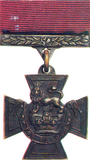
Arnold Horace Santo Waters
Major, 218th Field Company. Royal Engineers
- Register No.
- 1278 (Alf's numbering, from The Register of the Victoria Cross, 1997)
- Rank
- Major (register: Acting Major) all Majors →
- Unit
- 218th Field Company. Royal Engineers (register: Corps of Royal Engineers) all Corps of Royal Engineers VCs →
- Date of action
- 4 November 1918 on this day → all of 1918 →
- Conflict / campaign
- First World War
- London Gazette
- 13th February 1919 on this day → all of 1919 →
- Born
- 23rd September 1886 at Plymouth, Devon
- Died
- 22nd January 1981 at Four Oaks, Sutton Coldfield, Warwickshire
- Memorial / grave
- Sutton Coldfield Crematorium, Royal Engineers Museum, Chatham, Kent
- Medal held by
- the Royal Engineers Museum, Brompton Barracks,
Digest of citation
On the 4th November 1918, as his Field Company were building a bridge over the Oise-Sambre Canal, near Ors, France, from the outset they had come under heavy artillery and machine-gun fire at close range. The building party suffering severe casualties in addition to the bridge being damaged. On hearing that all his officers had been either killed or wounded, he went forward personally, to supervise, until the bridge's completion. During this time he worked on cork floats, all the time under extremely intense fire, from the enemy, at point-blank range. The success of this operation was entirely due to his bravery and the example he set, even though it seemed impossible that he could escape death under the enemy fire
From Alf Askin's research notes
Reproduced as Alf wrote it, c. 2000–2005. Spelling and abbreviations are his own.
WATERS, Arnold Horace Santo. (reg No. 1278).
Major. 218th Field Company. Royal Engineers.
London Gazetted on 13th February 1919.
VC Medal's Custodian is the Royal Engineers Museum, Brompton Barracks, Chatham, Kent.
Born on 23rd September 1886 at Plymouth, Devon.
Died on 22nd January 1981 at Four Oaks, Sutton Coldfield, Warwickshire.
Memorial at Sutton Coldfield Crematorium, Royal Engineers Museum, Chatham, Kent.
Digest of Citation reads: On the 4th November 1918, as his Field Company were building a bridge over the Oise-Sambre Canal, near Ors, France, from the outset they had come under heavy artillery and machine-gun fire at close range. The building party suffering severe casualties in addition to the bridge being damaged. On hearing that all his officers had been either killed or wounded, he went forward personally, to supervise, until the bridge's completion. During this time he worked on cork floats, all the time under extremely intense fire, from the enemy, at point-blank range. The success of this operation was entirely due to his bravery and the example he set, even though it seemed impossible that he could escape death under the enemy fire.
Additional information:. Major Sir Arnold Waters was also made a Commander of the Order of the British Empire (CBE); a Companion of the Distinguished Service Order (DSO) and he also held the Military Cross (MC). Major Sir Arnold Waters was the son of the Reverend Richard and Abigail Waters. Dedicated in Plymouth at the Hoe Grammar School. As an engineer, working for Wilcock and Raikes, Consultant Engineers he had worked in the Rhymney Valley and Eastern Valleys of South Wales. On 30th January 1915 he joined the Royal Engineers as a Second Lieutenant, going off to serve in the European War (WW I). Here he was awarded the Military Cross (July 1917 ) and the Distinguished Service Order, which was London Gazetted on 3rd June 1918. He was also Mentioned in Despatches in June 1918 . The presentation of the Victoria Cross was decided after King George V, after seeing his record, that a Bar to the Distinguished Service Order would be inadequate for such a deed.
Additional information
Major Sir Arnold Waters was also made a Commander of the Order of the British Empire (CBE); a Companion of the Distinguished Service Order (DSO) and he also held the Military Cross (MC). Major Sir Arnold Waters was the son of the Reverend Richard and Abigail Waters. Dedicated in Plymouth at the Hoe Grammar School. As an engineer, working for Wilcock and Raikes, Consultant Engineers he had worked in the Rhymney Valley and Eastern Valleys of South Wales. On 30th January 1915 he joined the Royal Engineers as a Second Lieutenant, going off to serve in the European War (WW I). Here he was awarded the Military Cross (July 1917 ) and the Distinguished Service Order, which was London Gazetted on 3rd June 1918. He was also Mentioned in Despatches in June 1918 . The presentation of the Victoria Cross was decided after King George V, after seeing his record, that a Bar to the Distinguished Service Order would be inadequate for such a deed.
Chatham, Kent.
Visit the grave or memorial
Alf recorded the memorial as: Sutton Coldfield Crematorium, Royal Engineers Museum, Chatham, Kent
Map links open a search for the place name Alf recorded; please check opening times and exact locations before travelling. Many VC graves have since been restored by the Victoria Cross Trust.
Research this recipient further
Would you like to honour Arnold Horace Santo Waters by sponsoring this page from £1 a month — in memory of someone, in your own name or for your company? Sponsor this page.